

How To Have A Healthy Mind For Better Performance

No matter what the softball off-season looks like for you, it is a great opportunity to work on creating habits that will help your brain stay healthy as the grind ramps back up.
Let's dive in and look more closely at the things you can do to help yourself prepare for next season.
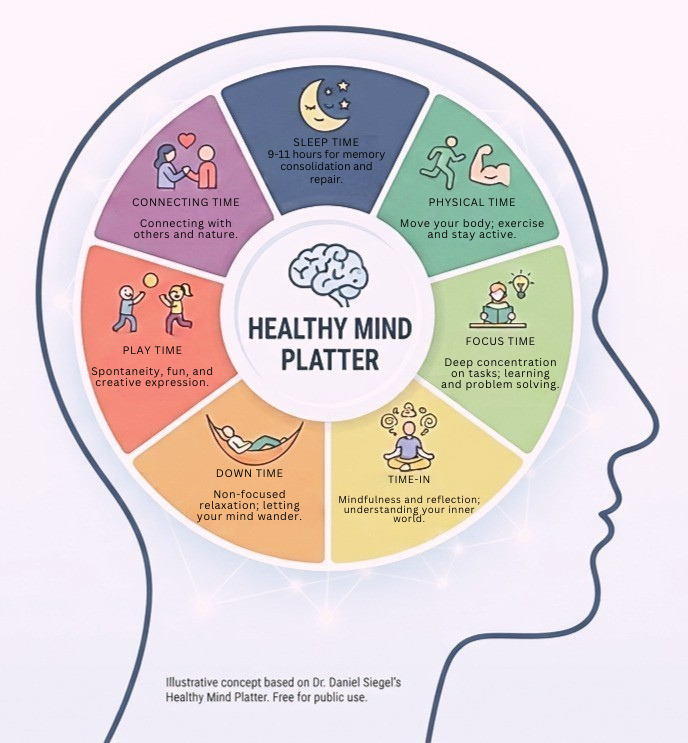
The Healthy Mind Platter
The Healthy Mind Platter is a synthesis of many research studies that presents a combination of seven actions we can take to keep our brains primed and ready to do our best (Rock & Siegel, 2011; Poelmans et al., 2012). What scientists have found is that if you practice each one of the seven behaviors and actions listed below each day, you are setting your brain up for its best performance.
1) Focus time. Focus time involves intentionally focusing on a specific goal or purpose and directing your attention to working toward it without interruption. For example, you set a goal of hitting 10 balls off the tee with a specific outcome or working on a specific mechanic. While you complete this task, you focus solely on your goal without interruption.
2) Playtime. Playtime happens when you are spontaneous, creative, and doing something new. This is a fun one, but one we can easily skip when we have a lot of practice, games, or work to do. A simple example of playtime could be trying different games to play during warm-ups (hacky sack, pepper, etc.) with teammates, or having a dance-off to start practice.
3) Connecting time. Connecting time is when you socialize with other people in person in a meaningful way. For those of us who are introverts, this can be a challenge.
4) Time in. Time in occurs when you turn your focus inward to how you feel inside. If you've ever reflected on the day, your performance, or an interaction, that's time in. Time in can also happen when you practice being present in the current moment.
5) Physical time. This one should be easy for you softballers. Physical time means moving your body through aerobic activity or other physical exercise. When you are practicing, playing games, or even playing another sport, getting your activity in each day is easier. However, even on your off days, you want to move your body in some way. This could be as simple as a walk through your neighborhood or a visit to your favorite stores.
6) Downtime. Sometimes during the day, we just need to think about and do nothing. Your brain is a thinking machine and will go until you literally have nothing left (especially if you tackle complicated tasks or high-emotion or high-energy states). Your brain could probably use some downtime more often.
7) Sleep time. This element of the Healthy Mind Platter is the only one with a required time allotment. For your brain to consolidate what you've been learning, process thoughts and memories, and recover, you need quality rest. This means sleep without interruption. Athletes ages 12 to 18 need 9 to 12 hours of sleep each night for their brains to recover, process information, and perform at their best (Canty, 2022). Getting enough restorative sleep will also help you reduce the likelihood of injury, restore physical energy and power stores (hit or throw the ball harder!), improve tracking and reaction time, and solidify your understanding of softball plays, mechanics, and the mental adjustments you want to make. If you're headed to a tournament, try to slip in extra naps (even 20-30 minutes can help) before, during, and after to give your brain a little extra rest for the heavy work it's about to do (USOPC, 2026).
The cool thing about the Healthy Mind Platter is that there isn't a set time recommendation for each element (except for sleep). Just work on getting each one of them in every day for the best results. Your brain will thank you for it!
Dr. Megan Buning is a Certified Mental Performance Consultant (C.M.P.C.) with over a decade of experience training the mental game.
References
Canty, G. (2022, November). Sleep for health and sports performance. Children's Mercy Hospital. Retrieved from https://www.childrensmercy.org/parent-ish/2022/11/sports-sleep/
Rock, D., & Siegel, D. J. (2011). The Healthy Mind Platter. NeuroLeadership Journal, 4.
Poelmans, S., Rock, D., Siegel, D., & Payne, J. (2012). The Healthy Mind Platter. NeuroLeadership Journal, (4,. 1-23.
USOPC. (2026). Sleep. Retrieved from https://www.usopc.org/sleep